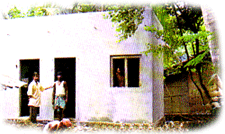
The beneficiary should be as far as possible involve in the
construction of house. The beneficiaries may make their own
arrangements for construction material, engage skilled workmen
and also contribute family labour. The beneficiaries will have
complete freedom as to the manner of construction of the houses.
This will result in economy in cost, ensure quality of
construction, lead to greater satisfaction and acceptance of the
house by the beneficiary. The
responsibility for the construction of house will thus be on the
beneficiary himself /herself.
No hard and fast type design is prescribed for VAMBAY dwelling
units. However, the plinth area of a new house should normally
be not less than 15 sq. mtr. The lay out, size and type design
of VAMBAY dwelling units would depend on the local condition and
preferences of the beneficiary.
The barrier free concept may be incorporated in all the VAMBAY
houses. In areas frequented by natural calamites such as fire,
flood, cyclones, earthquakes etc. incorporation of disaster
resistance features in design shall be made compulsory.
The implementation of VAMBAY would be dovetailed and synergised
with other programmes such as SJSRY and NSDP. The funds
available to the State under NSDP should be used for
environmental improvement and funds under SJSRY shall be
utilized for income upgrading activities through selfemployment
ventures, particu larly for women who are members of self-help (DWCUA)
groups.
Though there is a provision in the unit cost of a VAMBAY unit
for provision of infrastructure the Urban Local Body will need
to mobilise other resources for provision of water supply,
sanitation electricity etc. Community Infrastructure and
availability of social infrastructure such as schools,
hospitals, transport links etc are mandatory for sanction of
VAMBAY projects. Community infrastructure and social
infrastructure including green areas, open spaces and
recreational areas must be an integral part of VAMBAY designing.
The availability of drinking water supply should be ensured by
the concerned Urban Local Body. Where necessary, a hand pump
should be installed on the site before the work is started from
the funds available under Urban Water Supply Programmes, other
similar programmes or through Municipal resources, 25% of the
funds under the scheme will be spent in providing water &
sanitation which includes 20% earmarked for Community Sanitation
Project- Nirmal Bharat Abhiyan.