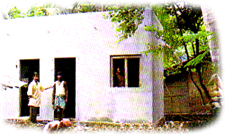
Shelter is a basic human requirement. For a shelterless person, getting a house brings about a profound social change in his status and welfare, endowing him with an identity and integrating him with his social milieu.
Valmiki Ambedkar Awas Yojana (VAMBAY) is a centrally sponsored scheme for the benefit of Slum Dwellers. The scheme is primarily aimed at ameliorating the housing problems for the Slum Dwellers living Below Poverty Line in different towns and cities of the
State .
The objective of Valmiki Ambedkar Awas Yojana (VAMBAY) is primarily to provide shelter or upgrade the existing shelter for people living Below Poverty Line in Urban Slums, with a view to achieve the goal of
"Shelter
for All".
The objective is also to utilize this initiative to achieve the Habitat goal of slumless cities. Equally important is the objective to provide not just shelter for the urban poor but also a healthy and enabling urban environment, to help them to come out of their poverty level. To this end, there is need to dovetail VAMBAY with NSDP and SJSRY to ensure that shelter delivery, environment improvement and income upgradation
for the urban poor are synergised.
The target group under the VAMBAY will be slum dwellers in Urban areas who are below the poverty line including members of the EWS who do not posses adequate shelter. However, preference is to be given to people below poverty line.
For the purpose of VAMBAY it is proposed to adopt the slum
definition in the 2001 census, as follows:
All areas notified as "Slum" by State /Local Government and UT Administration under any Act.
All areas recognized as "Slum" by State/Local Government and UT Administration, which have not been formally notified as slum under any Act.
A compact area of at least 300 population or about 60-70 households of poorly built congested tenements, in an unhygienic environment usually with inadequate infrastructure and lacking in proper sanitation and drinking water facilities.
The definition of malin basti or slum is to be taken in a wider sense to cover not only inadequacy of houses or tenements but also other basic amenities such as Water Supply, toilet facilities, disposal system etc., which make habitation livable and environment friendly. It is for the local
authorities to see that the water supply in the slum areas is suitably augmented either by providing connections or at least increasing the number of stand posts to take the availability to the minimum desired level of one public source for 20 families.
Another very important basic amenities for slum dwellers
especially in congested metropolitan cities is the lack of
rudimentary toilet facilities. A new national City Sanitation
Project under the title of 'Nirmal Bharat Abhiyan' being
launched in the slums all over the Country. Existing public
toilets developed by local bodies in and around slums often
become non-functional on account of lack of day-to-day
maintenance. Both the cost of construction and the cost of
maintenance can be significantly reduced and the Project ma de
self-supporting if the tasks are entrusted to community based
organisation of slum dwellers. The sanitation units, notably
urinals, WCs and bath units - may be constructed by the local
body or the State PWD or any other agency preferably with the
aid of NGOs and selected by the community of slum dwellers will
be entrusted the job of maintaining the toilet block in a clean
condition against a monthly salary of Rs 1500-2000. In some
cases, a residential quarter for him may be built on the first
floor of the toilet block.
It has been found that this involvement of the community based
on organization not only leads to better upkeep of the toilet
but also makes itself financing at a cost much less than that
made available by other private originations.
20% of the
total allocation under this VAMBAY will be used for
infrastructure [at] 50% as grant from GOI and 50% as loan
from HUDCO. The State Govt/Local Bodies of course will free to
supplement with their own grant or subsidy as the case may be.
Since in many slum areas, some form of public toilet may be
already in existence, the possibility of retrofitting/repairing
and upgrading the existing toilet complex which have become
unserviceable for various reasons such as 5 lack of sewerage system, lack of septic tanks,
inadequate water supply etc. should be explored, since it
significantly reduces the per unit cost of construction
vis-à-vis units may be constructed by the local body or the
State PWD or any other agency preferably with the aid of NGOs
and participation through labour by the local slum dwellers but
the design and implementation of the toilet units may be made in
such a way that they can be kept in good hygienic condition with
access to water supply and electric power connection.
The average cost per such a community toilet unit or seat has
been estimated to be Rs 40,000/- per seat. Therefore, a 10-seat
or a 20 -seat toilet block meant for men, women and children
with separate compartments for each group and special design
features will cost around Rs 4 lakhs or Rs 8 lakhs respectively.
The existing 'pay and use toilets scheme' operated by HUDCO
which allows a subsidy per seat to NGOs, Clubs, registered and
unregistered societies, etc. can also be availed of in the
vicinity of slums. Similarly, the wage employment component of
the existing Swarna Jayanti Shahari Rozgar Yojana (SJSRY) can
also be utilized for augmenting the resources for construction
of toilets. Such convergence of existing plan and centrally
sponsored schemes will make the project cost effective.
Each toilet block will be maintained by the slum dwellers who
will make a monthly contribution of Rs 20 per family and obtain
a monthly pass or family card. The overall programmes can then
be construction of new toilets and retrofitting where only
improvement is required. The existing integrated Low Cost
Sanitation (ILCS) Programme can be suitably dovetailed into this
programme.